
Course Registration
At Emory, course registration is an on-going process, not a singular event. Building your schedule each semester will take time, patience, and planning.
Academic Advising
Your Emory College Academic Advisor is your key support through the process of registration.
Summer Academic Advising Appointments: You will meet your Emory College Academic Advisor during your first advising session in June, Registration 101, and again in a smaller group session in July, Registration Workshop, where you will review your potential schedule and clarify any questions you have.
Network of Advisors
You have a network of advisors to help you at Emory, consisting of:
- Emory College Academic Advisors
- Major/Minor Advisors
- Specialized Advisors
- Pre-Health(including nursing)
- Pre-BBA
- Dual Degree
- Career Coaches at Pathways Center
The Academic Big Picture
Students at a liberal arts institution, like Emory, learn a variety of ways to think critically about the world, communicate knowledge, collect and analyze data, and solve problems. Emory's liberal arts curriculum is designed to support exploration while keeping you on track to graduate in four years. Learn about graduation requirements here.
To earn your degree, you'll complete:
- 126 Total Credit Hours
- General Education Requirements (GERs)
- Requirements for at least one major
- Elective courses
General Education Requirements (GERs)
- GERs introduce different ways of thinking, learning, and engaging across disciplines.
- They are completed gradually over your four years and often overlap with majors and electives.
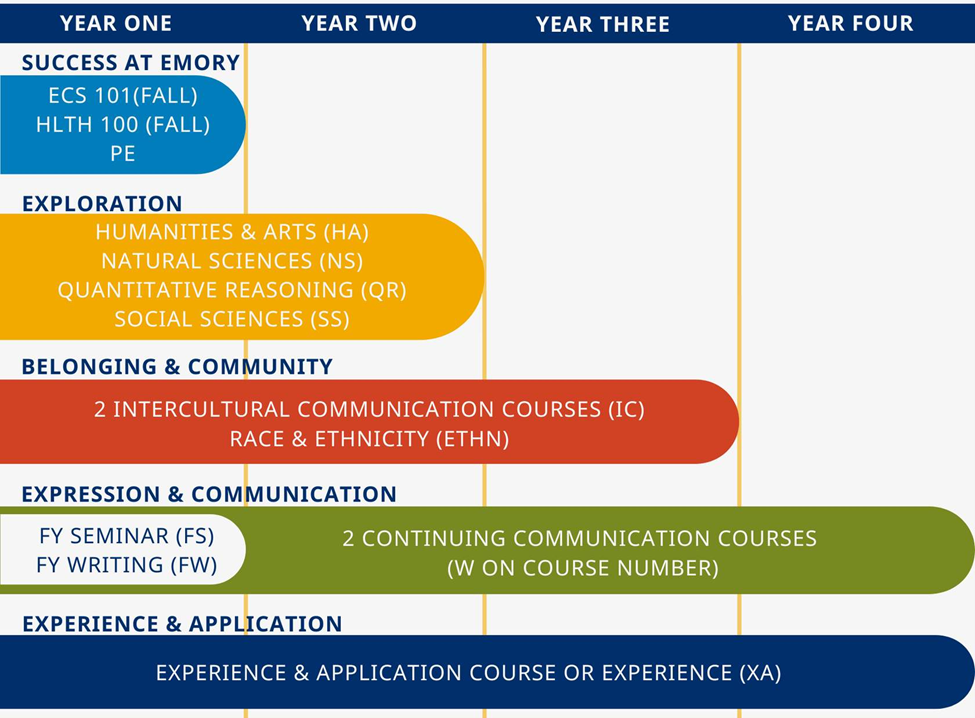
First-Year Academic Requirements
In your first year, you'll complete a small set of required courses designed to support your transition to Emory and help you explore academic interests.
First-Year students are required to complete the following:
- ECS 101: Emory Essentials (Fall ONLY)
- HLTH 100: It's Your Health and Well-being (Fall ONLY)
- Physical Education (PE) (Fall or Spring)
- First-Year Seminar (Fall or Spring)
- First-Year Writing (Fall or Spring) **can be met with AP/IB credit
Majors, minors, & electives
Learn more about majors, minors, & electives
credits, Placement & Preparation
Some students arrive with prior AP/IB or college credit, language experience, or take courses that require preparation. These factors can influence which classes you start in.
Explore details about:
- AP/IB and previous college credit: Test scores and college coursework count towards some GERs and prerequisites. More information can be found here.
- Language placement & fluency: Most languages require a placement exam. Learn more about them here.
- Course prerequisites & preparation: Some courses require advance preparation. Learn more about them here.
Building your Fall Schedule
- Use Course Atlas to explore courses and prepare for registration with the Shopping Cart feature.
- Shopping Carts open on July 1, 2026; before that, you can explore courses but you won't be able to add them to your shopping cart.
- Keep these tips in mind as you build your schedule for Fall:
- First-year students must register for HLTH 100 and ECS 101 in the fall semester. All ECS 101 and HLTH 100 section follow a common curriculum, so choose the section that works best with your schedule.
- First-year students should register for 15-17 total credits. The minimum number of credits is 12 and the maximum is 19.
- A credit hour reflects weekly class time and workload. Emory College courses vary from 1-5 credit hours.
- Choose which of the other first year classes you will take in fall and which ones you'll target for spring: First-Year Seminar, PE, First-Year Writing (FYW GER can be fulfilled with AP/IB equivalencies).
Build a schedule that works for you by choosing a mix of classes that meet your required GERs, prerequisites, and/or look interesting to you.
Registration Tools
- Course Atlas is where you can search for classes, build schedule options, and view course information. Learn how to search for classes here.
- OPUS is the system where you register for classes and make changes to your schedule.
- Shopping Cart: Use your shopping cart in Course Atlas to hold all courses that interest you. Your shopping cart automatically pushes to OPUS when it's time to register. Having multiple courses in your shopping cart will give you more options when you register in OPUS. Get tips about how to build your schedule using your shopping cart here.
- Emory College Catalog is where you can review requirements for your intended major/minor and learn about Emory's academic policies
Course Registration
Course registration is when you officially enroll in your fall classes through OPUS. It is helpful to think of registration as a process, rather than a singular event. Most students do not get a "perfect" schedule on the first day. Be flexible! Having multiple options prepared in your shopping cart will make your registration easier. Nearly all students adjust their schedules during the Add/Drop/Swap period, which is detailed in Step Five.
Registration is open from August 4 - 6, 2026 for first-year students and is broken into two enrollment periods:
- August 4 at 12:00 p.m. (noon) - 11:59 p.m. EDT: Register for up to 8 credit hours.
- August 5 at 12:00 p.m. (noon) - August 6 at 11:59 p.m. EDT: Register for remaining credit hours.
When Add/Drop/Swap opens on August 12 at 12 p.m. (noon) EDT, all Emory students can make changes to their schedules.
Registration TipsNeed more help?
Use the step-by-step guide to registration. Having trouble? Find the troubleshooting guide here.
Add/Drop/Swap
Add/Drop/Swap opens to all Emory students so they can make changes to their schedules. See tips about Add/Drop/Swap here.
- A/D/S period: August 12 at 12 p.m. (noon) EDT through September 4, 2026.
- Some courses may have waitlists, but not all courses will. If a course does have a waitlist, it might not open until A/D/S begins.
Waitlists vs. Swap/If
There are two ways to go on a waitlist for a course: either by joining the waitlist directly or utilizing the swap/if function. View the chart below for help deciding which way to go.

Note: You will not come off the waitlist if you have any of the conflicts outlined on this chart.